
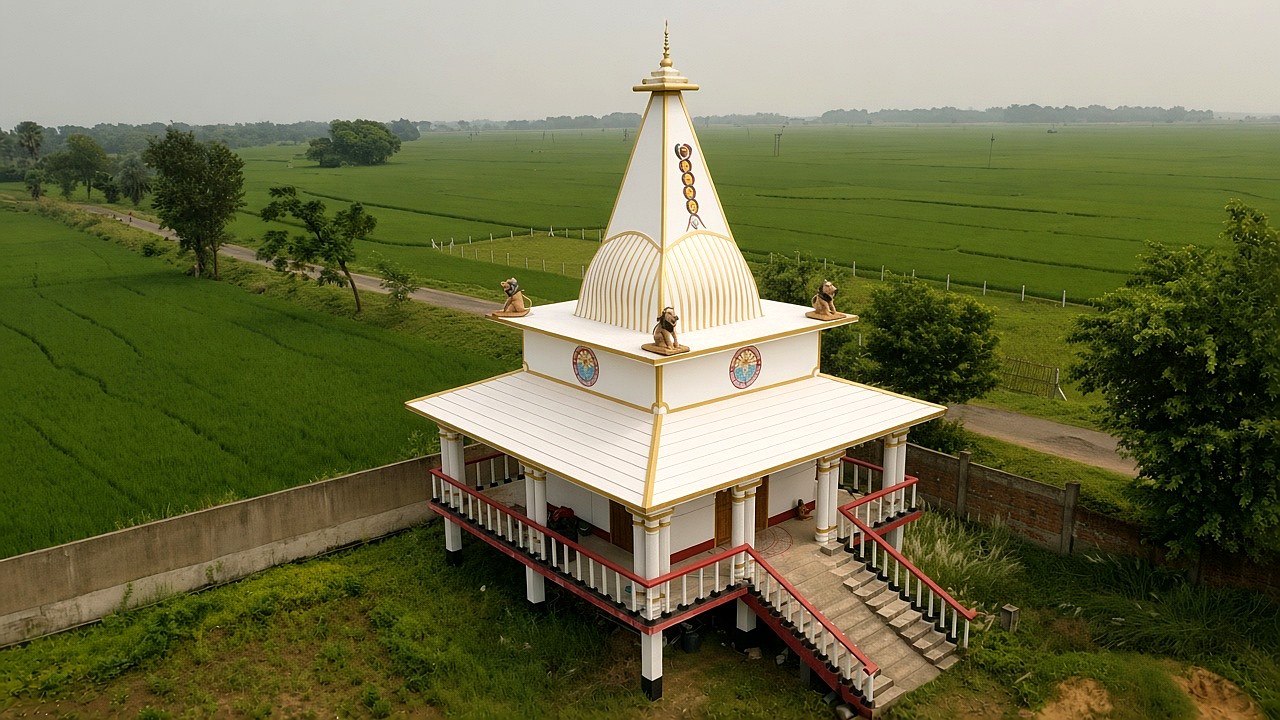
Shree Meenananda Ashram · Sri Meenananda Tirthanath · 2026-09-19
A day at Shree Meenananda Ashram in Gopikantapur, Kopai, Birbhum is the life of a Shakta household: the shrine is tended, people are fed, animals are looked after, and the evening gathers the house in kirtan. Guests who wish to share that rhythm are received with care. Please call before travelling so the Ashram can welcome you and confirm the day’s programme.
This is the living centre of Meenananda Foundation — the same house whose public face also keeps an address at Pirtala, Garia, Kolkata 700152. In Gopikantapur the work is close to the soil: paddy, a temple courtyard, a kitchen for whoever has come, and a Guru-parampara held by Sri Meenananda Tirthanath and Guruma Minakshi Devyomba. Guests find a home of sadhana that also feeds, clothes, teaches, and sings.
Morning: the house wakes toward the shrine
Morning at the Ashram begins with ordinary holiness. Lamps, water, flowers, and the first greeting of the Deity belong to the people who live here. The courtyard holds the night’s coolness a little longer than the road. Someone sweeps. Someone looks in on the cows. Someone sees to the kitchen fire. None of this is staged for a camera; it is how a tantric house keeps faith with the day.
Sri Meenananda Tirthanath teaches Tantra as a complete life. Guruji’s oft-spoken line sits easily beside a broom and a milk-pail: “Tantra is the religion of mankind but humanity is the religion of this universe.” If the sacred is present, it is present in the first cup of tea offered to a guest, in the care of the shrine, and in the way the household speaks to one another. A seeker who has read Gujhya Gyan will recognise the same teaching on the ground: knowledge, puja, and seva are one path with several doors.
Those who come for diksha still enter through this morning. Diksha is a personal transmission received directly from the Guru; contact the Ashram to begin the conversation. Until then, sit quietly, help if you are asked, and let the house show you its pace.
Midday: kitchen, courtyard, and the work of hands
By late morning the Ashram is a working household. Vegetables are cut. Rice is watched. Someone may be mending, carrying water, or sitting with a visitor who has come from Bolpur, from Kolkata, or from a neighbouring village. Prasad, when it is offered, is food that has first been given — a sharing, not a performance. If you are able, the most graceful way to belong for an hour is to join seva: kitchen work, folding cloth, keeping company with the animals, or helping a neighbour who has come with a need.
Clothing seva has a documented place in this calendar of care. On Guruma Minakshi Devyomba’s advent tithi — 13 May 2024 and 29 April 2025 — the Ashram’s YouTube record shows clothes and essentials given at the house. Other days of giving continue in the same spirit.
Named pujas follow tithi and the Bisuddha Siddhanta panjika on the calendar. Kali Puja in 2026 falls on 8 November — Dipanvita Amavasya, 21 Kartik 1433. Festival days thicken the courtyard; ordinary days keep the same kitchen and the same cows. Both belong to sadhana.
Afternoon: study, rest, and the quiet of the pond
Afternoon is often the gentlest part of an Ashram day. Heat sits on the laterite and the paddy. People rest, read, or talk in the shade. Guruji’s book Jagatik Ajagatik is among the books. A Bengali line of this house is kept exactly: “অদৃশ্যমান বিবর্তনই বিজ্ঞান” — invisible evolution itself is science. The pond’s still surface holds the same hint: much is happening that the eye does not advertise.
Some guests come with questions of tithi or a family observance; some simply sit. Speak softly near the shrine. Ask before you photograph people. Offer help before you offer advice. You are in someone’s home.
Evening: kirtan, lamps, and the close of the day
Evening is the Ashram’s public song. Kirtan is held daily; please confirm by phone, then follow the lamps. The courtyard changes character as diyas are lit. Voices gather. A guest who has never sat for Bengali kirtan will still recognise the hospitality: a place is made, prasad may follow, and the house sings to the Divine as one would sing in a family that knows its own hymns.
On some occasions the Ashram has received guest kirtan from Padma Shri Purna Das Baul and from Kirtan Samrat Suman Bhattacharya. Most evenings are the house’s own voice, including the devotion of Guruji’s album Charan Dasi. Sit. Listen. If you know the refrain, join it.
When the singing rests, people eat, animals are seen to, and the shrine is left in order. A visitor leaving toward Bolpur or Garia carries the taste of a household that kept them.
To plan that arrival, use the Visit page and the numbers the house publishes: +91 9831117349 and +91 8240908608, or write to [email protected]. More such portraits of this life live on the Journal hub. Come as a guest. The day will teach you how the house lives.
FAQ
What does a guest actually do during a day at the Ashram?
You arrive by arrangement, greet the household, and follow the day’s living order — shrine, kitchen, rest, and evening kirtan. Help is welcome when it is asked for. The grace of a first visit is to watch how the house already moves, then to place your hands where they are useful.
Do I need to stay from morning to night?
A full day is a beautiful way to meet Gopikantapur, and a shorter visit arranged by phone is also received with care. Please call before travelling so the Ashram can welcome you and confirm the day’s programme. The household will tell you what the date can hold.
May I join the kitchen or cow care on a first visit?
Yes, when the house invites you. Seva here is worship with sleeves rolled up: food, cloth, animals, and neighbourly care. Say that you have come to help, then accept the task you are given — even if it is simply sitting with someone, folding a sari, or keeping a cow company.
How do I greet Guruji or Guruma if they are present?
Come as you would to elders of a spiritual household: simply, cleanly, and without a speech prepared for a stage. Sri Meenananda Tirthanath and Guruma Minakshi Devyomba receive people in the life of the Ashram. If you have come about diksha, say so quietly; the conversation belongs to them, and it continues in person.
What should I bring for an ordinary day?
Bring modest clothing suitable for a shrine and a village courtyard, a willingness to sit on the floor, and the courtesy of a phone call already made. Offerings of flowers, fruit, or kitchen help are in the spirit of the house. Ask when you arrive what is needed that day rather than arriving with a programme of your own.
Where do I confirm the day’s kirtan or puja?
Telephone the Ashram on +91 9831117349 or +91 8240908608, or write to [email protected]. Evening kirtan is held daily, and named pujas follow the Ashram calendar. A call lets the household prepare a welcome worthy of a guest.