
Shree Meenananda Ashram · Sri Meenananda Tirthanath · 2026-09-19
Seva at Shree Meenananda Ashram is worship performed with the hands. In Gopikantapur, Kopai, Birbhum, the same household that lights the shrine also cooks, folds cloth, tends animals, and keeps faith with neighbours. Food, clothing, gau seva, and ordinary kindness are not extras beside sadhana. They are how a Shakta house proves that Shakti is present in the living world. Please call before travelling so the Ashram can welcome you and confirm the day’s programme.
Sri Meenananda Tirthanath often says: “Tantra is the religion of mankind but humanity is the religion of this universe.” In this courtyard that sentence has a ladle, a needle, and a handful of fodder. Guruma Minakshi Devyomba’s household makes the teaching visible. Meenananda Foundation is the public name of that turning toward society — an Ashram that feeds, clothes, teaches, and looks after life around it.
Food as prasad continued
A kitchen in an Ashram is a shrine that happens to steam. Rice, dal, and whatever the day has provided are cooked for the people who are there — residents, guests, and those who have come with hunger as their only introduction. When food has first been offered, it is received as prasad: hospitality with a lineage.
A community meal under the shamiana is part of this house’s remembered hospitality. Photographs of such gatherings are kept with respect. The grace of the meal is the sitting together, not a published count of plates. If you come with hands free, the kitchen will know what to do with them. Chopping, stirring, serving, washing — these are mudras of a very practical kind.
Those who wish to support this work through the year can begin on the Seva page. The conversation is human. Needs change with harvest, festival, and the village’s week. The Ashram will tell you what the house can use.
Clothing given in the name of the day
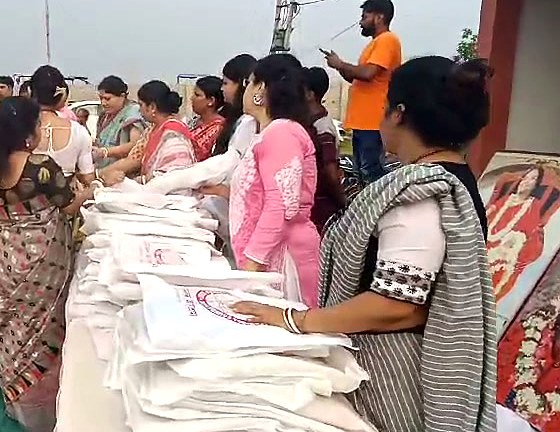
Cloth is dignity you can fold. On Guruma Minakshi Devyomba’s advent tithi the Ashram has documented clothing seva on its official YouTube channel: 13 May 2024 and 29 April 2025, with the song Amar pujar thalay accompanying the later record. Those dates are named because they were filmed and kept as part of the house’s public memory.
The same spirit runs through quieter days. A sari, a shawl, a child’s school shirt — given without theatre — continue the tithi’s kindness. If you have clean garments to offer, ask the household how they wish to receive them. Distribution is an Ashram act, shaped by people who know their neighbours.
Festival nights such as Kali Puja thicken the courtyard; clothing seva reminds us that Ma is also worshipped in the covering of a human back. The calendar will show you when the year turns toward named pujas. Seva does not wait for a red-letter day.
Animals, land, and the neighbour
Gau seva is one of this house’s ordinary holinesses. Cows of the Ashram are household beings. Feeding, cleaning, and keeping company are worship. Other lives around the grounds are kept in the same regard so far as the house can tend them. A separate portrait of that care is offered in gau seva at the Ashram.
Neighbourly care is less photogenic and just as central. Someone needs a hearing. Someone needs an escort to the shrine. Someone needs the Foundation’s Kolkata door at Pirtala, Garia 700152, to know their name. Humanity as religion is this: remaining available.
A guest who has read Gujhya Gyan will already have met the teaching that body, speech, and mind become instruments of worship. Seva is that teaching with wet hands. The pond, the courtyard, and the kitchen path are the mandala.
How a volunteer belongs
Come first as a guest of the day. Use Visit, telephone +91 9831117349 or +91 8240908608, or write to [email protected]. Say whether you can cook, carry, sit with elders, or help with animals. Accept the task you are given. A first seva is often small, which is how a house learns your pace and you learn the house.
If your coming is also a coming toward mantra and Guru-parampara, keep that wish distinct and sincere. Diksha is a personal transmission received directly from the Guru; contact the Ashram to begin the conversation. Seva prepares a seeker in the old way: by softening self-importance. It is a beautiful preparation. It is still seva, complete in itself, even when no further conversation is asked.
Sri Meenananda Tirthanath’s book Jagatik Ajagatik and the album Charan Dasi belong to the same household that folds cloth. Knowledge, song, and service are three lamps on one altar. Walk between them as the day requires. More such writing lives on the Journal hub.
FAQ
What kinds of seva can a visitor join?
Kitchen work, clothing, animal care, cleaning, and sitting with whoever needs company are the everyday forms. Festival days add extra hands for flowers, lamps, and the movement of guests. The household assigns what is useful that day.
How do I offer clothes or dry rations?
Telephone or write first, then bring what the Ashram has asked for. Clothing seva is already part of Guruma’s advent tithi memory for 2024 and 2025. Quiet gifts on ordinary days are received in the same spirit when the house can store and give them well.
Is feeding people the same as a public langar every day?
Hospitality is part of Ashram life, and prasad is shared when food has been offered. The kitchen cooks for those who are present. A large community meal is arranged as the household arranges it. Call, and you will be told how to sit at the plate that exists that day.
Can seva be offered from Kolkata?
Meenananda Foundation keeps an address at Pirtala, Garia, Kolkata 700152, alongside the Ashram in Gopikantapur, Birbhum 731201. Write or telephone to ask how a city-based helper can serve. Some work is local to the village; some conversations begin in Garia.
Does serving in the kitchen replace puja?
In this house they complete each other. Puja turns the heart toward the Deity; seva turns the same heart toward the living world the Deity inhabits. Many residents move from shrine to kitchen in a single morning. A guest is welcome at both doors.
I want to help and I also want to ask about diksha. How do I say that?
Say both things plainly when you write or call. Help with the day’s work, and keep the wish for initiation in the conversation meant for it. Diksha is a personal transmission received directly from the Guru; contact the Ashram to begin the conversation. The kitchen will still be glad of your hands.
Related reading
- Gau seva and caring for animals at an Ashram
- A day at Shree Meenananda Ashram in Gopikantapur
- Shakti, consciousness, and compassionate daily living
Kali Puja in Bengal: devotion, preparation, and community Journal What is diksha and how does a seeker prepare?