
Shree Meenananda Ashram · Sri Meenananda Tirthanath · 2026-09-19
Kali Puja in Bengal is the night when a household and a neighbourhood turn together toward Ma — dark, beloved, and near. At Shree Meenananda Ashram in Gopikantapur, Kopai, Birbhum, that night in 2026 is 8 November: Dipanvita Amavasya, 21 Kartik 1433 by the Bisuddha Siddhanta panjika. Preparation is itself worship: cleaning, cooking, gathering flowers, and making a place for the community to stand before the Mother. Please call before travelling so the Ashram can welcome you and confirm the day’s programme.
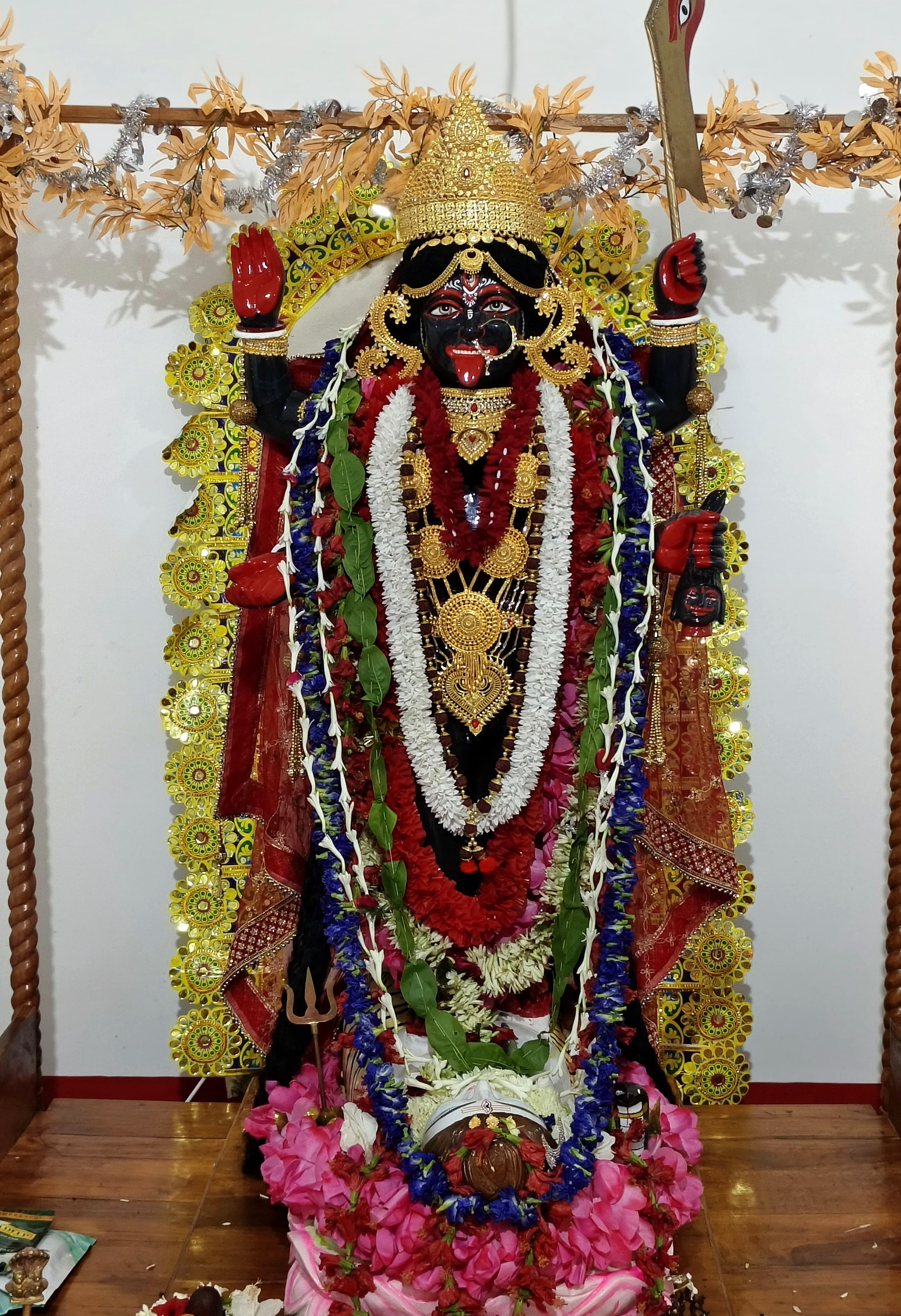
Bengalis know this tithi in the bones. Dipanvita Amavasya is the new-moon night of lights, when Kali is worshipped with a tenderness that coexists with her fierce iconography. The sword and the garland, the red hibiscus and the lamp, the cry of “Ma” from a courtyard that has cooked all afternoon — these are one grammar of love. At this Ashram the grammar is Shakta and specific: Sri Meenananda Tirthanath and Guruma Minakshi Devyomba keep a living shrine, and the Foundation turns that shrine toward whoever comes.
Ma in the Bengali heart
To speak of Kali Puja only as an event is to miss the relationship. In Bengal, Ma is scolded, praised, feared in the way one fears a mother who sees through pretence, and adored in the kitchen as much as in the temple. Ramprasad’s songs taught a language in which philosophy and domestic speech sit at the same plate. That language still fits a Birbhum courtyard.
Shree Meenananda Ashram lives a tantric Shakta path in which Kali is not a seasonal decoration. The calendar names public observances; the daily lamp names the rest of the year. When Kartik darkens toward Amavasya, the house simply becomes more visibly what it already is: a place of the Mother.
Sri Meenananda Tirthanath’s teaching holds a wide compassion around that intensity. “Tantra is the religion of mankind but humanity is the religion of this universe.” Kali Puja, in this reading, is a night when humanity is invited to stand honestly before Shakti — then to feed the people who have stood there.
Preparing the house
Preparation for Kali Puja is a long kindness. Floors are washed. The shrine is dressed. Oil, wicks, flowers, and the kitchen’s extra work are taken up by whoever has hands. Seva and puja meet here without a join showing. Neighbours may come with offerings. Guests from Kolkata may arrive at Pirtala, Garia, or come through to Gopikantapur. The Ashram’s published phones — +91 9831117349 and +91 8240908608 — and the address at Birbhum 731201 are how a traveller begins that approach.
A guest who wishes to help should say so when they call. Folding cloth, cutting fruit, keeping children gently at the edge of the shrine, sitting with an elder — these are festival sadhana. Those who want a wider picture of that work can read how seva is practised as worship through the year, including clothing given on Guruma’s advent tithi in 2024 and 2025.
Puja on this night has a public face and a household face. For the range of observances the Ashram discusses with families through the year, see Puja. Kali Puja and Kali Homa are among the named conversations of that room. What the night itself will hold in Gopikantapur is confirmed by the household as the tithi nears.
Community, prasad, and the morning after
A Kali Puja crowd in Bengal is a community thinking with its feet: people come, wait, bow, receive, and go home smelling of incense and fried offerings. At an Ashram the same movement is slower and more personal. Prasad is the Mother’s hospitality continued through human hands. Eat with gratitude. Leave the courtyard cleaner than you found it if you can.
The morning after Amavasya has its own quiet. Lamps are tended. Remaining food is shared. The cows of the house are still the cows of the house. Festival glory returns to ordinary sadhana — which is, in this lineage, the point. A night of Kali is a peak of visibility; the path is the year.
Those who wish to understand the Shakta ground of this festival can sit with Gujhya Gyan and with the Bengal chapters of that path of study. Knowledge prepares the mind; the night prepares the heart. Both are welcome in Gopikantapur.
Coming for the night
Please call before travelling so the Ashram can welcome you and confirm the day’s programme. Roads around Bolpur and Kopai fill with other households keeping the same tithi. The Ashram receives guests as a home receives guests — by knowing you are coming.
If your journey is also a journey toward mantra and Guru-parampara, read the Diksha page first. Diksha is a personal transmission received directly from the Guru; contact the Ashram to begin the conversation. Kali Puja can stir that wish. The wish is heard in human speech, in Gopikantapur, in the presence of Sri Meenananda Tirthanath.
Write to [email protected], or telephone. More writing from this household is on the Journal hub. Ma is already in the year. The Amavasya of 8 November 2026 is one night when the whole courtyard says so together.
FAQ
When is Kali Puja at the Ashram in 2026?
Kali Puja is observed on 8 November 2026 — Dipanvita Amavasya, 21 Kartik 1433, following the Bisuddha Siddhanta panjika used by the Ashram. Telephone before you travel, so the household can tell you how that night will be kept in Gopikantapur.
Is Kali Puja only a Kolkata festival?
Kolkata’s public Kali Puja is famous, and Bengal’s villages keep the same tithi with their own shrines and courtyards. Shree Meenananda Ashram observes the night in Gopikantapur, Kopai, Birbhum, as a living Shakta household. The Mother is worshipped wherever a lamp is honestly lit.
How should a first-time guest prepare?
Wear modest clothing suitable for a shrine, come by arrangement, and offer help if you have hands free. Learn the date from the Ashram calendar, then let the household guide you once you arrive. Flowers, fruit, and a quiet mind are always in season.
Will there be kirtan as well as puja?
Evening kirtan is held daily at the Ashram, and festival nights gather extra song and extra lamps. Confirm the programme by phone. Puja, homa when it is undertaken, and Nama belong together in this house as several expressions of one devotion.
Can I request a family Kali Puja at another time of year?
The Ashram speaks with families about puja and yajna through a dedicated conversation. Begin at the Puja page and write with the need of your household. The Kartik Amavasya night remains the great public tithi; other observances are arranged in person with the house.
Where do I confirm travel for 8 November?
Call +91 9831117349 or +91 8240908608, or write to [email protected]. The Ashram is at Gopikantapur, Kopai, Birbhum 731201, with a Kolkata address at Pirtala, Garia 700152. A welcome is prepared for those who say they are coming.
Related reading
- Tantra in Bengal: a respectful introduction
- Puja and yajna: their roles and differences
- Understanding tithi, nakshatra, and the Bengali panjika
What evening kirtan means in Ashram life Journal Seva as worship: food, clothing, animals, and neighbourly care