
Shree Meenananda Ashram · Sri Meenananda Tirthanath · 2026-09-19
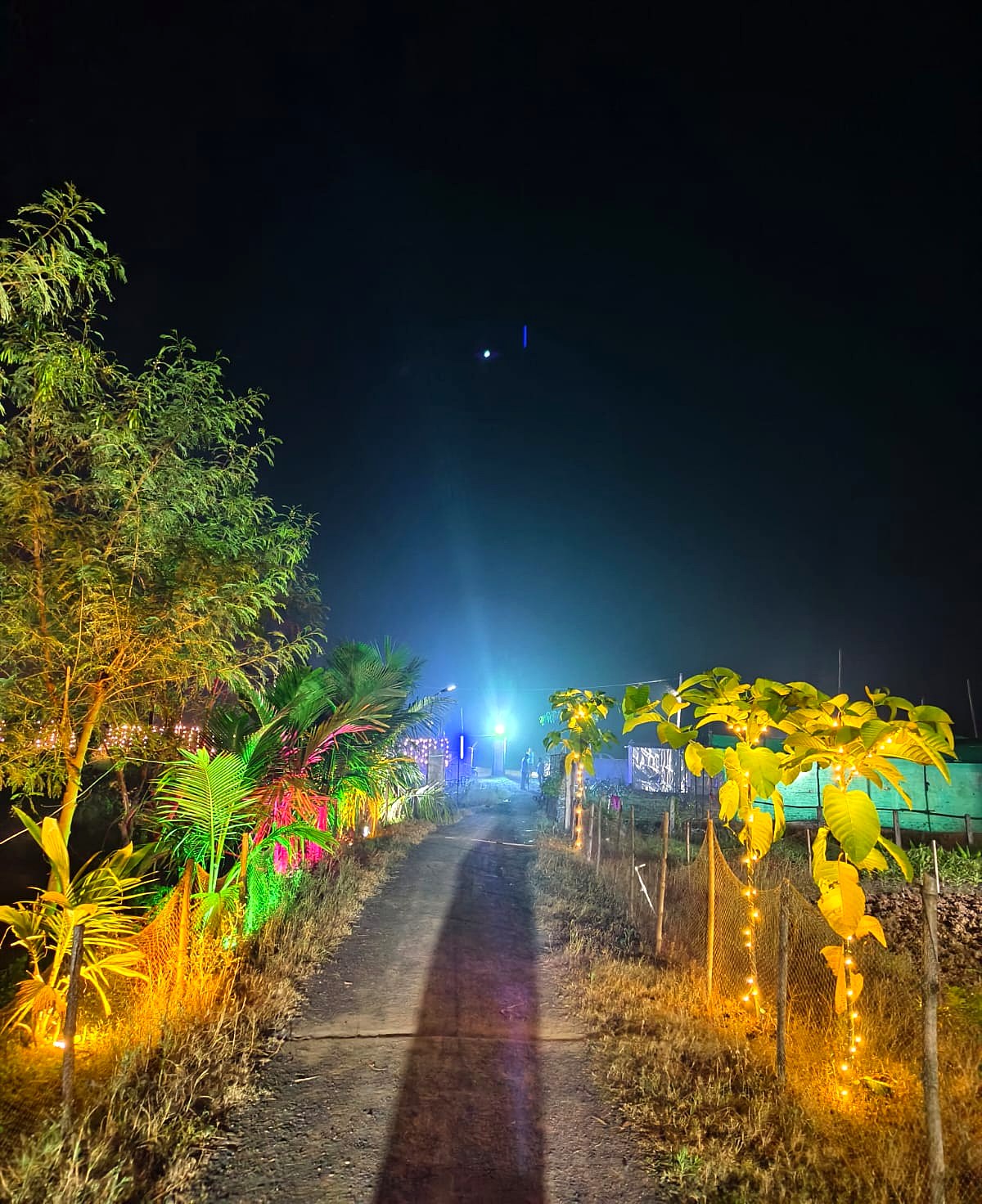
Evening kirtan at Shree Meenananda Ashram is the household’s daily gathering in song. As the light leaves the paddy around Gopikantapur, Kopai, Birbhum, lamps are lit, voices find a common Nama, and the courtyard becomes a single listening. Evening kirtan is held daily; please confirm by phone. Please call before travelling so the Ashram can welcome you and confirm the day’s programme.
Kirtan here is worship that can be joined with the body you already have: breath, memory, and a willingness to sit. It is the public face of a Shakta house whose inner work is sadhana, puja, and seva. Sri Meenananda Tirthanath is a teacher and a singer. Guruma Minakshi Devyomba keeps the same household. Together they have raised an Ashram in which the evening’s music is as much a duty of love as the morning’s lamp.
Nama as the evening fire
In Bengal, kirtan has long been a way for a community to remember the Divine together. At this Ashram the evening is not a concert with numbered seats. It is the fire of Nama kindled in a courtyard that has already cooked, swept, and tended animals through the day. Someone leads. Others answer. A guest who does not know the words can still keep time with the heart.
Guruji’s album Charan Dasi belongs to this current of devotion — the stance of one who lives at the Guru’s feet. A listener who comes from far away may first meet that voice on a recording; in Gopikantapur the same current is a living evening. The refrain is simple enough for a child and deep enough for a lifetime of sadhana.
Sri Meenananda Tirthanath often says: “Tantra is the religion of mankind but humanity is the religion of this universe.” Kirtan is one way that sentence becomes audible. The neighbour is in the circle. The guest from Kolkata is in the circle. The person who spent the afternoon in the kitchen is in the circle. Humanity, in this house, has a melody.
How a guest sits
Arrive a little early if the household has asked you to. Wash, stand quietly near the shrine, and take the place you are shown. Phones rest. Photography waits for permission. If prasad is offered after the singing, receive it as you would food in a family — with both hands and with thanks.
You need courtesy more than a specialised vocabulary. If you know Vaishnava pads, Shakta hymns, or Baul turns of phrase, you will hear Bengal’s wide river of bhakti. If you know only silence, silence too can keep tala. A day at the Ashram shows how kitchen, cows, and shrine prepare the same people who later sing.
Guest musicians and the honour of the house
On given occasions the Ashram has received guest kirtan from Padma Shri Purna Das Baul and from Kirtan Samrat Suman Bhattacharya. Those evenings are remembered with gratitude. They show the house’s open door to Bengal’s great singers, and they remain evenings of worship first.
Most nights are quieter: the Ashram’s own voices, the courtyard’s own lamps, the village air. A first-time visitor who hopes for a named artist may still receive something rarer — a household that sings because it is time to sing. Confirm the programme when you call. The honour is in being received, whether the circle is small or the courtyard is full.
Kirtan, puja, and the year
Kirtan belongs to ordinary evenings and to the great nights of the calendar. When Kali Puja comes — in 2026 on 8 November, Dipanvita Amavasya, 21 Kartik 1433 of the Bisuddha Siddhanta reckoning — the same courtyard that sings at dusk also prepares for the Mother’s public worship. Named pujas are listed on the calendar. The daily evening remains the daily evening: a practice you can return to after the festival lamps have been put away.
Puja and yajna have their own work of fire, offering, and sankalpa; kirtan is the work of Name. In this house they keep company. A seeker reading Gujhya Gyan will see that mantra, devotion, and ethical life are taught as one fabric. The evening makes that fabric audible for anyone who will sit.
After the last refrain
When the singing rests, the Ashram is still a household. People eat. The path of diyas is left in order. Someone sees to the animals. A guest returning toward Bolpur, or toward the Foundation’s Kolkata address at Pirtala, Garia 700152, carries a simple memory: a place that opened its evening and asked for nothing more than presence.
To sit with that presence, use Visit. Telephone +91 9831117349 or +91 8240908608, or write to [email protected]. If your coming is also a coming toward diksha, say so when you write; Diksha is a personal transmission received directly from the Guru; contact the Ashram to begin the conversation. The evening kirtan will still be there, lamps ready, for the guest who only wished to sing.
Further portraits of this life are gathered on the Journal hub. Come, confirm, and take your place in the circle.
FAQ
Is evening kirtan held every day?
Evening kirtan is held daily at Shree Meenananda Ashram. Please confirm by phone, because a living household sometimes shapes an evening around a puja, a guest, or the needs of the day. A call lets the Ashram welcome you at the right hour.
What time should I arrive?
The public clock of the shrine is given by the household when you telephone. Please call before travelling so the Ashram can welcome you and confirm the day’s programme. Arrive with enough quiet to sit before the first refrain.
May I record the kirtan on my phone?
Ask the household first. An evening of Nama is worship, and people in the circle have not all consented to a camera. If permission is given, keep the device still and unobtrusive. The truest recording is to learn a line and carry it home in the voice.
Do I need to know Bengali kirtan to sit?
You are welcome with whatever language you have. Much of the feeling is in the refrain, the clap, and the shared sitting. Listen for a line that returns, and join when you can. Courtesy and attention are the only required grammar.
Who leads the singing?
Sri Meenananda Tirthanath is a singer of this path, and the household carries the evening together. Guest kirtan has included Padma Shri Purna Das Baul and Kirtan Samrat Suman Bhattacharya. On an ordinary night you will hear the Ashram’s own voices, including the devotion held in the album Charan Dasi.
Can children sit for kirtan?
Children who can sit with respect are part of a household evening. Keep them close, step outside if they need to move, and let them receive prasad as the adults do — as guests of the Mother and of the house.
Related reading
- A day at Shree Meenananda Ashram in Gopikantapur
- Kali Puja in Bengal: devotion, preparation, and community
- Visiting a spiritual Ashram near Bolpur and Santiniketan
A day at Shree Meenananda Ashram in Gopikantapur Journal Kali Puja in Bengal: devotion, preparation, and community