
Sacred Learning
Devī Upanishad
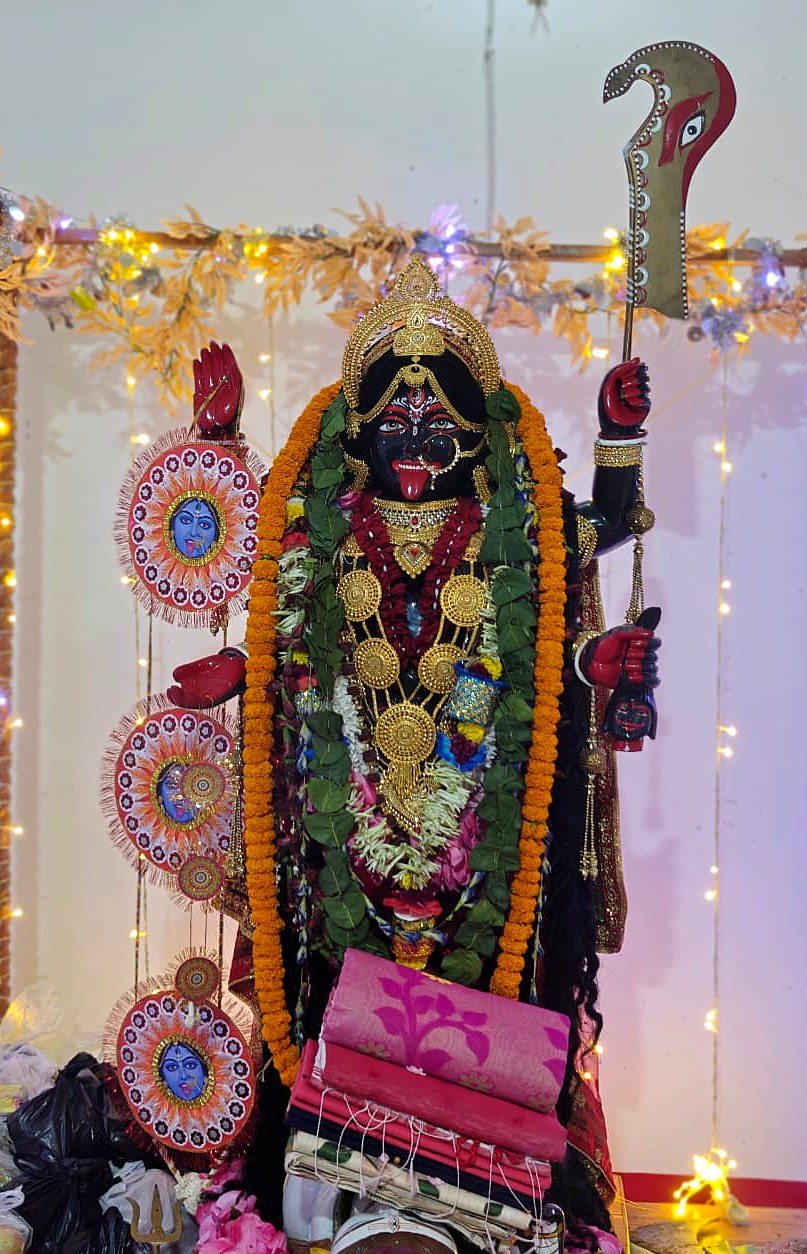
The gods ask the Great Goddess who She is, and She answers as the reality from which the world appears.
Devī Upaniṣad
The gods ask the Great Goddess who She is, and She answers as the reality from which the world appears.
- Veda Atharvaveda, in the affiliation used on this site.
- Classification Śākta Upanishad; Muktika 81 here (Sanskrit Documents also prints 89/108).
- Shape Twenty-two numbered units after the śānti in the Sanskrit Documents recension.
A simple introduction
The gods come before the Great Goddess with a question that opens this whole Śākta hearing: “Who are you?” She answers as Brahman itself — the form of the Real — and as the source from which the paired world of prakṛti and puruṣa arises, empty and not-empty together. Praise and philosophy speak with one mouth here. The language of devotion already carries a claim about what is ultimately there: Devī is the ground of existence and the many forms through which existence appears.
A newcomer can sit with five names the opening already carries. Brahman is the vastness She claims as Her own form. Prakṛti is nature in its unfolding. Puruṣa is the witness-companion of that unfolding. Vidyā is the knowing that lights an object. Avidyā is the veiling that makes the same world look empty of Her. None of these names is a rival deity; they are ways the one answer moves.
This house opens the text from the public-domain Devanagari recension at Sanskrit Documents, sitting beside the principal Upanishads already welcomed in this library. The Devī Upanishad is short enough to hear in one sitting and large enough to keep returning to, because every later Śākta identification of the Goddess with the Self is already named in this first answer.
What the text teaches
The question is the teaching
The drama of the gods standing before Mahādevī is already a philosophy of approach: knowledge begins as a greeting, not as a catalogue of names.
Her answer refuses to be one more deity in a list. She speaks as the form of Brahman, so worship and inquiry sit at the same seat.
Ground and appearance together
She is the ground of existence and the many forms through which existence appears — full and apparently empty in one breath.
A reader who holds only the hymn, or only the metaphysics, hears half the sentence.
Nature and witness
Prakṛti and puruṣa rise from Her as a pair. Nature unfolds; the witness accompanies that unfolding.
The text does not ask the newcomer to choose between a Goddess of the world and a Goddess of consciousness.
Knowing and veiling
Vidyā lights an object so it can be known. Avidyā is the same world’s capacity to look empty of Her.
Both belong to the one answer; neither is treated as an enemy to be hunted in a manual of technique.
Hymn as philosophy
The praise-language of the opening is already a claim about ultimate reality.
Later public stotras in this house’s mantra library sit beside this Upanishad as devotion already welcomed, not as a substitute for the recension.
How to read it
Read the Devī Upanishad as a first hearing, not as a ritual handbook. Let the question “Who are you?” stay in the mouth while the answer unfolds. Where the recension later thickens into mantra syllables or recitation counts, this introduction keeps to the philosophical claim already spoken in the opening.
A reliable edition matters. Numbering differs between the Muktika list used on this site and the handbook printed with the Sanskrit Documents recension; both numbers remain in the compact facts above. Follow a named recension before drawing conclusions from a single line.
Return to the opening question whenever later names crowd the page. The Goddess’s answer remains the measure of every identification that follows, and a slow sitting with that answer is the gift of this short text.
Key terms
- ब्रह्मन् brahman
- The vastness She names as Her own form.
- प्रकृति prakṛti
- Nature unfolding from Her.
- पुरुष puruṣa
- The witness-companion of that unfolding.
- विद्या vidyā
- Knowing that lights an object.
- अविद्या avidyā
- The veiling that makes the world look empty of Her.
A passage to begin with
Devī Upaniṣad 1 (Sanskrit Documents numbering)
सर्वे वै देवा देवीमुपतस्थुः । कासि त्वं महादेवि । साब्रवीदहं ब्रह्मस्वरूपिणी । मत्तः प्रकृतिपुरुषात्मकं जगच्छून्यं चाशून्यं च ।
All the gods approached the Goddess. ‘Who are you, Great Goddess?’ She said: ‘I am the form of Brahman. From me is the world of prakṛti and puruṣa — empty and not-empty.’
Context and connections
Source text
Beside Bahvṛca and Tripurā
The Bahvṛca Upanishad hears Devī as one at the beginning who emits the world-egg. The Tripurā Upanishad hears Her through triads. This page keeps those as neighbouring hearings, not as one collapsed text.
Tradition
Śākta nondual hearing
Later Śākta commentarial traditions hear this identification of Devī with Brahman as a compact nondual vision. That later hearing is named here as tradition, not as a verse of this recension.
Meenananda hearing
How this house hears it
Meenananda hears the Goddess’s answer as the same inquiry that looks at life unfolding and consciousness unfolding in one sky. The living interval between names is where the house sits to listen.
Authentic texts and further reading
- Devī Upaniṣad, Sanskrit Documents Public-domain Devanagari recension of this Upanishad. Sanskrit (Devanagari) · Public-domain Devanagari recension as posted 2026 Opened 2026-09-20
- Upanishads overview, Vedic Heritage Portal Institutional overview of the Upanishads as Vedānta and Veda-family affiliation. Sanskrit (Devanagari) · Vedic Heritage Portal public page, accessed 2026-09-20 Opened 2026-09-20
- GRETIL register of Indic e-texts Catalogue of Indic e-texts for locating named recensions. Sanskrit (Devanagari) · GRETIL public register Opened 2026-09-20