
Sacred Learning
Living concepts
A small graph of words that open the scripture room.
Each card is a doorway, not a closed treatise. Follow a thread to a mantra, a verse, a deity, or a living page already on this site.
Another name lives in this circle. Try Gāyatrī, Oṃ, or ṚV.
Ātman
Ātman is the innermost Self—the principle of conscious presence that the Upanishads distinguish from the changing body, senses, and mind. Different schools inte
Brahman
The vastness named in the Upanishads, heard here as the ground of puja and silence. In the Devī Upanishad the Goddess answers as the form of Brahman — the Real
Dharma
The holding of a life so that it can be offered — field, duty, and compassion together.
Karma
Action, and the way a deed ripens. In the Ashram, karma is also seva done without grabbing the fruit.
Yajña
Offering into fire, and any work given as offering. Homa in the courtyard is one form; a kitchen can be another.
Yoga
Joining. The Gītā names evenness as yoga; this Ashram also names sitting, kirtan, and honest work.
Bhakti
Devotion as a way of knowing — love that keeps a name on the tongue.
Jñāna
Knowing that steadies the house. Study, hearing, and the Guru’s word walk together.
Śakti
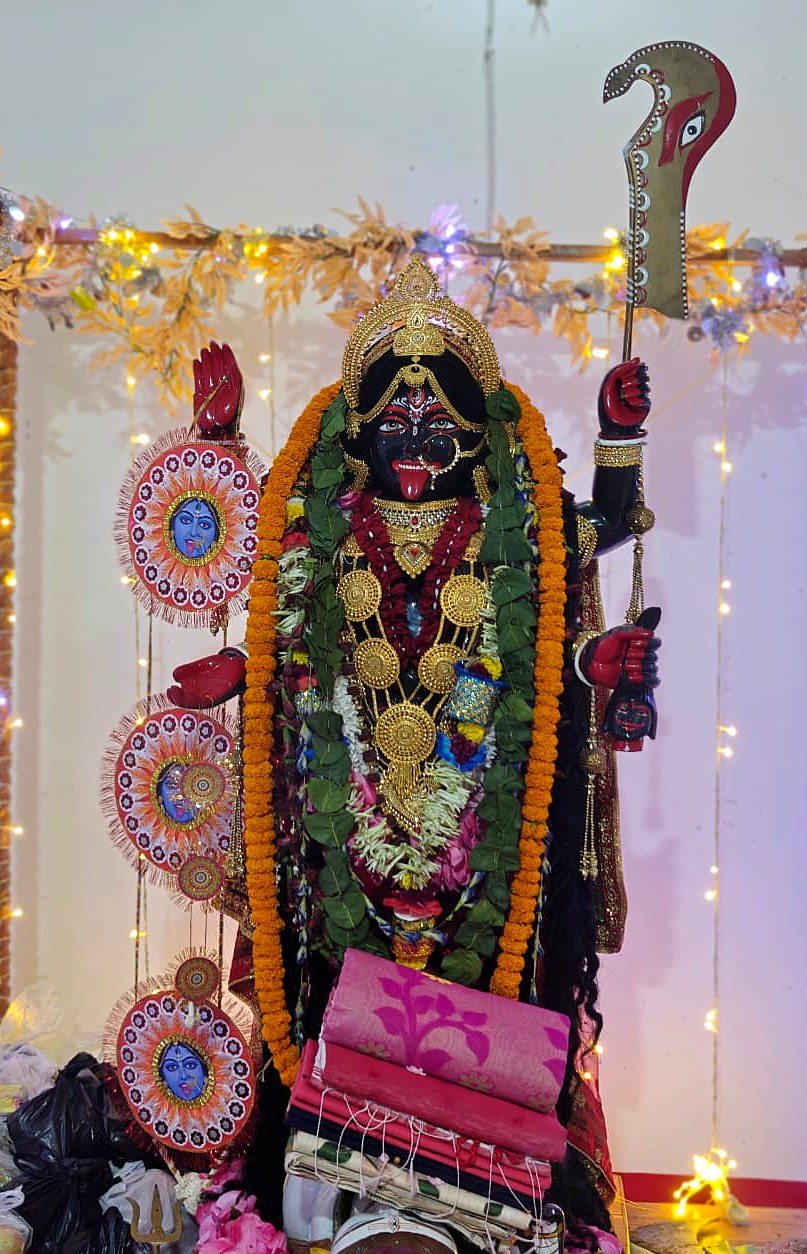
The Goddess as power and as Mother. This Ashram’s public teaching keeps Her close to Kali puja and to daily work. In the Śākta Upanishads Śakti is the living ap
Mokṣa
Release. Named with humility: a direction of sadhana, received through the Guru’s care.
Mantra
Measured sound given for remembrance. Public mantras live in the library; diksha-mantras stay with the Guru.
Guru
The living teacher. In this Ashram, Sri Meenananda Tirthanath; the word also names the whole parampara.
Devī
The Goddess as named in these Upanishads — Brahman, Mother, and the one who answers.
Prakṛti
Root nature — the unfolding field from which forms arise. In the Sītā Upanishad, Sītā is remembered as mūlaprakṛti, the primordial prakṛti beside which puruṣa s
Tripurā
Three cities, three paths; the Goddess as Tripurasundarī in this circle.
Śrīvidyā
A name of contemplative knowing of Śrī. Operational encodings are not published here.
Śrīcakra
Sacred geometry named in the Bhāvanā Upanishad as nine śaktis. Educational diagram, not a consecrated yantra.
Yantra
A holding-diagram. Public pages describe; they do not initiate.
Bhāvanā
Sustained contemplative understanding, not casual imagining. The Bhāvanā Upanishad uses bhāvanā to let the Śrīcakra be heard as an interior map of the human bei
Vidyā
Knowing that lights its object so meaning becomes clear. The Sarasvatīrahasya Upanishad asks how such understanding arises, and names Sarasvatī as that illumina
Vāk
Speech as sacred sound, paired with mind in the Sāvitrī Upanishad. Vāk is the living word through which knowledge becomes audible.
Śrī
Auspicious presence of the shrine and of Saubhāgyalakṣmī.
Annapūrṇā
The Goddess of nourishment heard as knowledge that fills.
Sāvitrī
The paired principle with Savitṛ — earth, waters, speech.
Nonduality
Secondless Brahman named Lalitā in the Bahvṛca Upanishad.
Subtle body
Nāḍīs and inner faculties as the Bhāvanā Upanishad lists them.
Unseen evolution
Unseen evolution is science. Tantra leaves no room for a “God of the Gaps”; it seeks the Divine through disciplined practice, direct experience, reason, and evi
Sītā
Sītā of the Upanishad is heard as primordial prakṛti and divine power. The Vālmīki Rāmāyaṇa remains the epic door; this name sits beside it as a metaphysical he