
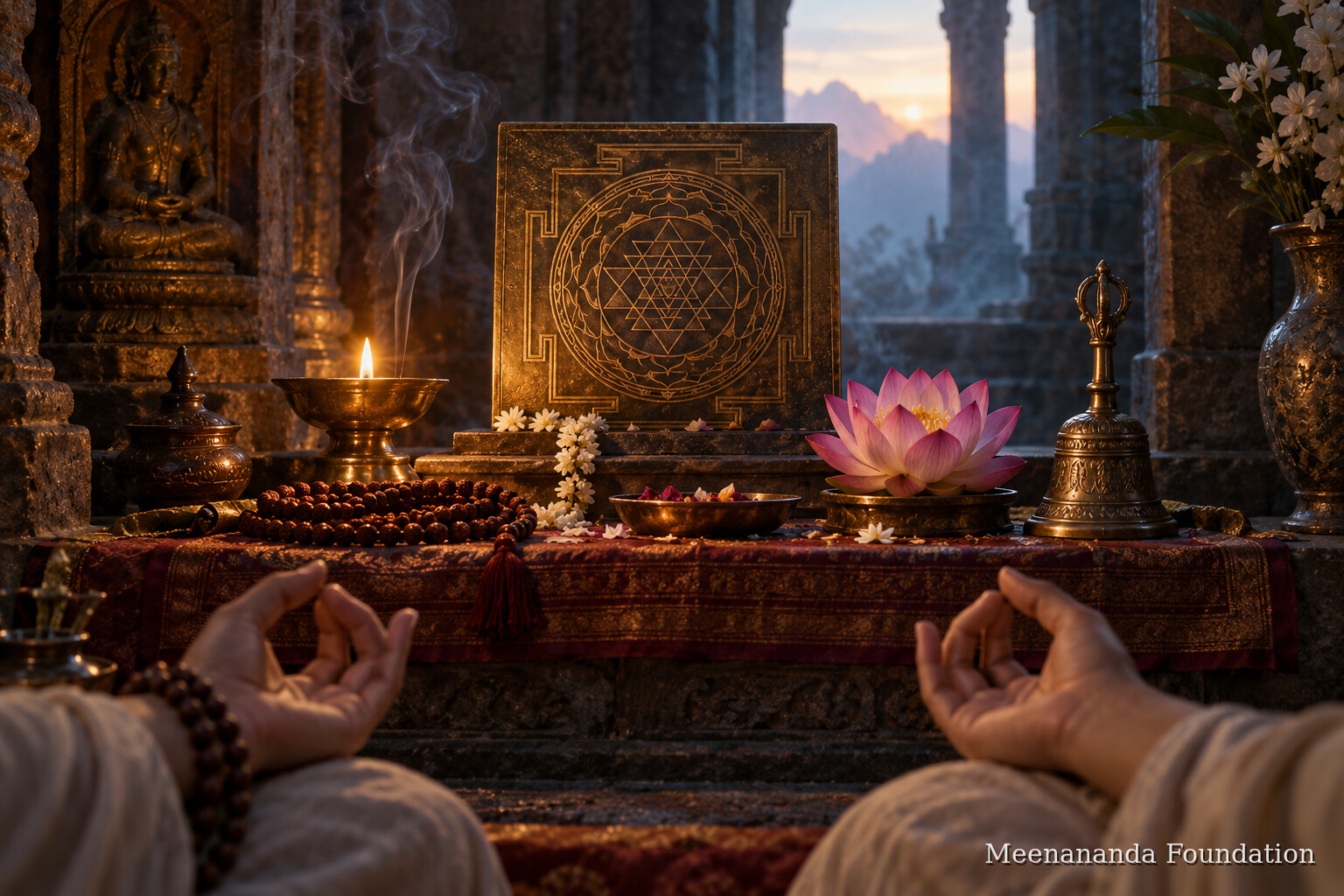
Gujhya Gyan
Tantric Pūjā Paddhati: Bāhya, Antar and Rahasya Pūjā
A careful public introduction to the main forms and ordinary grammar of Tantric worship, the meaning of Rahasya Pūjā, and why initiated portions remain with a trustworthy Guru.
Published by Shree Meenananda Foundation as public education. Not diksha.
A Tantric pūjā paddhati is not one universal rite. It is a disciplined way of establishing sacred attention through body, speech, mind, image, mantra, offering and meditation. Form changes with deity, scripture, lineage, initiation, region, occasion and the sādhaka’s adhikāra. This chapter maps those methods at a public level. It does not give secret mantras, lineage-specific nyāsa, sexual rites, intoxicant use, animal sacrifice, or instructions that depend on dīkṣā and direct supervision.
Meenananda principle: What is public may be studied with care. What is initiated is received through a trustworthy Guru and an accountable lineage. Secrecy protects sacred teaching — it must not hide coercion, exploitation or harm.
What does ‘paddhati’ mean?
Paddhati means a path, sequence or practical method. In pūjā it orders preparation, purification, saṅkalpa, invocation, upacāra, mantra, meditation, closing and the offering of the fruit of the act. So a paddhati is not only a to-do list. It carries a philosophy: who is worshipped, where the deity’s presence is felt, how the worshipper is transformed, and how outer action relates to inner knowing.
Sequence, vocabulary and emphasis differ across scriptures and lineages. A Bengali household Kālī pūjā, Śrīvidyā pūjā, Śaiva temple service and Kaula inner sādhana should not be named as one identical paddhati.
Public household outlines — not this Ashram’s unpublished official paddhati — are in the puja paddhati room. This chapter is a comparative Tantric framework and a public explanation of Rahasya Pūjā. Initiation and safeguarding: Guru, dīkṣā and ethical discernment. Vocabulary: Mantra, yantra, mudrā. Bengal: Tantra in Bengal.
Three ways to see the variety of pūjā
By occasion and purpose
| Form | Plain sense | Public description |
|---|---|---|
| Nitya pūjā | Regular or daily worship | Ordered remembrance, offering, japa and dedication. |
| Naimittika pūjā | Occasional worship | Done on a tithi, festival, reception, annual rite, vrata or other named occasion. |
| Kāmya pūjā | Worship tied to a particular wish | Within ethics, adhikāra and lineage limits. No guaranteed result. |
| Śānti or prāyaścitta | Restoring balance or acknowledging a fault | Prayer and rite in answer to imbalance, error or distress. Not a substitute for medicine, law or ordinary duty. |
| Festival or communal pūjā | Shared worship | Offering, recitation, song, prasad, hospitality and seva in a public gathering. |
By the field of worship
Bāhya pūjā (outer worship): a temple or shrine, mūrti, liṅga, yantra, ghaṭa, lamp, flowers, water, incense and other visible supports.
Mānasa or antar pūjā (inner worship): seat, deity, upacāra and pranāma are contemplated within awareness; outer supports may be few or absent.
Combined pūjā: outer action and inner meditation move together. A flower on the altar may also stand for an inner offering of attachment or a quality.
These are not simply “lower” and “higher.” Outer pūjā can hold deep meditation. Inner pūjā without preparation, ethics and attention can become mere imagining.
By lineage and ācāra
Tantric sources map several disciplined ways of life and sādhana. Names such as Vedācāra, Vaiṣṇavācāra, Śaivācāra, Dakṣiṇācāra, Vāmācāra, Siddhāntācāra and Kaulācāra appear; not every scripture or lineage explains them the same way. They should not be flattened into a simple ladder or an internet personality test.
Words such as paśu, vīra and divya are also used for a sādhaka’s nature and ritual adhikāra. They are not insults, social caste labels, or a licence to copy an “advanced” rite. Adhikāra here means qualification, preparation and authorisation.
An ordinary grammar of Tantric pūjā
There is no single sequence for every lineage, yet many paddhatis show familiar elements.
- Preparation and ethical fitness — cleanliness, a fitting place and time, honest purpose, needed supports, and freedom from intoxication or coercion.
- Ācamana and first purification — remembrance and cleansing according to one’s lineage.
- Āsana and the field — a steady seat and an ordered shrine.
- Remembrance of Guru, lineage and Gaṇeśa — bowing to the stream of knowledge and asking that obstacles be cleared.
- Saṅkalpa — naming occasion and purpose without promising miraculous fruit.
- Bhūtaśuddhi — re-imagining or recognising body and existence as sacred; the specific process may be restricted by lineage.
- Mātṛkā, kara and aṅga nyāsa — placing sacred sound on the body. Related mantras and acts may depend on dīkṣā; they should not be copied from isolated online fragments.
- Dhyāna — remembering the deity’s form, qualities and presence.
- Āvāhana and pratiṣṭhā — inviting or recognising sacred presence in a mūrti, ghaṭa, yantra, fire, the heart, or another authorised support.
- Upacāra — hospitality through water, fragrance, light, food, flowers, cloth and the like. Counts and substitutes differ by lineage.
- Mantra-japa and stotra — recitation and praise in a public prayer or in a mantra properly received.
- Homa, tarpaṇa or other limbs — present in some rites, not required in every pūjā; not to be done without knowledge and safety.
- Apology, visarjana and dedication — asking pardon for faults, closing the ritual presence with respect where that applies, and offering the fruit of the act.
- Prasad and seva — receiving grace in shared food, gift, care and responsible conduct.
This is an educational map. It is not the unpublished official paddhati of Shree Meenananda Foundation.
Some important forms of Tantric pūjā
Deity-centred pūjā
Worship is arranged around Kālī, Tārā, Durgā, Tripurasundarī, Śiva, Bhairava, Gaṇeśa or another form of the lineage. Dhyāna, mantra, yantra, upacāra and panjika differ. A mantra of one form should not be dropped mechanically into another pūjā.
Yantra or cakra pūjā
A yantra is treated as a mantra-body of the deity, not as ornament. Worship may move through enclosures, lotuses, triangles, attendant deities and the bindu. Śrīcakra pūjā is a well-known example, but the full method belongs to initiated Śrīvidyā sādhana.
Ghaṭa or kalaśa pūjā
A water-filled vessel becomes a support of sacred presence and auspicious fullness. Leaves, thread, deity and mantra differ by rite and region.
Homa
Offerings are made into consecrated fire with mantra. Homa has both religious and practical safety. A website should not encourage unsupervised fire rites, give recipes for combustible mixtures, or treat homa as a substitute for ordinary work.
Japa and puraścaraṇa
Japa is regular repetition of mantra. Puraścaraṇa can mean a larger sādhana that joins japa with limbs such as homa, tarpaṇa, abhiṣeka or feeding — according to scripture and lineage. Counts and rules are not the same everywhere. Puraścaraṇa of an initiated mantra belongs under a qualified Guru.
Mānasa pūjā
In mānasa pūjā the sādhaka contemplates the pīṭha, the deity and every upacāra within awareness. Its deeper sense is not daydream; it is a sacred relation — or unity — of worshipper, worship and the worshipped. Many lineages join outer and inner pūjā.
Communal and festival pūjā
Kālī, Durgā and other festival pūjās join song, recitation, prasad, hospitality, gift and shared memory. Public participation does not mean a lineage’s initiated inner portion is published. Announced Ashram dates are on Puja and festivals.
What is Rahasya Pūjā?
Rahasya means secret, intimate, inward or esoteric. Rahasya Pūjā is not one authorised ceremony, and it is wrong to call it only “midnight pūjā.” A pūjā whose full mantra, nyāsa, mudrā, dhyāna, materials, participants or explanation are limited by dīkṣā and adhikāra may be spoken of in the range of Rahasya Pūjā.
Traditional reasons for secrecy include:
- keeping an oral teaching stream intact;
- protecting the sādhaka from unprepared imitation;
- protecting concentration and vow;
- choosing a method according to a person’s qualification and responsibility;
- keeping sacred intimacy away from display and commerce.
Secrecy is never an excuse for abuse. No teacher may, in the name of “secret Tantra,” override consent, isolate a student, claim sexual rights, hide violence, order illegal acts, or block medical or legal help.
A public map of Rahasya Pūjā’s inner logic
Without publishing an initiated sequence, the inner reason can be named in five movements:
- Sacred entry: seeing daily identity and place as sacred through remembrance of Guru-lineage and purification.
- Divinity in the body: not rejecting the body as impure, but recognising it as a field of mantra and divine presence.
- Offering and transformation: dedicating experience, emotion and attachment to awareness; symbols hint at crossing one’s own limit.
- Yoga or non-separation: contemplating deity, mantra, Guru, sādhaka and world as deeply related or undivided, according to the lineage’s philosophy.
- Return with responsibility: not pride; closing in humility, ethical conduct, food-gift, dāna or seva.
This map is fit for public education. Secret bīja-mantras, lineage ciphers, complete nyāsa, techniques of sexual rite, intoxicant preparation, blood offering, animal sacrifice, coercive “tests,” or practices that risk medicine, law or fire should not be published as public instruction.
Pañcamakāra: why sensational readings mislead
Talk of rahasya or Vāmācāra often brings up the “five M-s” or pañcamakāra. Across scriptures, times and communities one finds literal use, authorised substitutes, symbolic reading and inner-yogic understanding. To call any one reading the rule of all Tantra is false.
The subject belongs under history and lineage study, not as a marketed licence to consume. Consent, restraint, law, health and non-harm are never optional. Meenananda’s public library will explain the heading and will not instruct the secret act.
A simple outline for public, uninitiated devotion
Ordinary devotion can stay modest:
- Clean the place and oneself.
- Sit quietly and take a resolve of truth and non-harm.
- Light a safe lamp; use electric light if fire is unsuitable.
- Offer clean water, a flower or fruit.
- Remember the iṣṭa-devatā with a public name or prayer.
- Sit in silence, read a verified stotra, or remember a widely known devotional mantra.
- Give thanks, ask pardon for faults, and dedicate the fruit for the good of all.
- Share food or do some seva.
This is a frame for ordinary devotion. It is not dīkṣā and not a substitute for any initiated paddhati.
How to test a published pūjā paddhati
- Are scripture, edition and editor named?
- Does the source call the sādhana public, or does it require dīkṣā?
- Do deity, mantra and action belong to the same lineage?
- Has a qualified person checked the Sanskrit/Bengali text and pronunciation?
- Are historical description and the Ashram’s present conduct kept distinct?
- Does the teacher honour consent, law, health and financial transparency?
- Does the material promise guaranteed wealth, control of others, a medical cure, or threaten a curse? Then do not trust it.
Frequently asked questions
Is Tantric pūjā wholly separate from all Hindu pūjā?
Tantric pūjā often gives special weight to mantra, nyāsa, dhyāna, yantra and the worshipper’s body as a sacred field. For centuries, though, Hindu rites have influenced one another; a hard wall between “Vedic” and “Tantric” elements may not be historically accurate.
Is Rahasya Pūjā necessarily a sexual rite?
No. Rahasya means esoteric or intimate; it is not automatically sexual. Some historical streams mention transgressive or sexual symbols and rites; many rahasya sādhanas are mantra, meditation, mānasa pūjā or a restricted pūjā sequence.
Can one learn Rahasya Pūjā from a website?
A website can teach history, ideas and ethics. It cannot give dīkṣā, test adhikāra, transmit a living mantra, or supervise a restricted rite.
Is midnight compulsory?
No. There is no universal rule that every Tantric or Rahasya Pūjā must be at midnight. Time depends on deity, tithi, lineage and vow.
Why do Tantric sādhakas worship differently on the same tithi?
Because tithi is only one factor. Deity, lineage, mantra, regional method, kulācāra, dīkṣā, vow and the sādhaka’s adhikāra can change the form of pūjā.
Pointers for source reading
This public introduction should be checked against reliable editions and knowledge in a qualified lineage. Further study often turns to texts such as the Kulārṇava Tantra, Śāradātilaka Tantra, Prapañcasāra, Mantramahodadhi, Mahānirvāṇa Tantra, the Tantrarāja Tantra of Śrīvidyā, and Bengal’s Tantrasāra / Bṛhat Tantrasāra stream. They do not all teach one paddhati. See Sources and further reading.
Editorial standing
This is an educational comparative overview. It is not the unpublished official paddhati of Shree Meenananda Foundation. Where the Ashram’s living practice is announced, it is labelled separately.